

 English
 日本語
日本語 한국어
한국어Industry News
 Home / News / Industry News / Export of Paper: HS Codes, Trade Data and Container Economics for Buyers
 Export of Paper: HS Codes, Trade Data and Container Economics for Buyers
 2026.09.30
 Industry News
Content
- 1 What the Export of Paper Covers at Customs Level
- 2 Where the Paper Trade Actually Flows
- 3 Sourcing Paper from China: What to Verify Before the First Order
- 4 Fiber Choice Changes Price, Paperwork, and Carbon
- 5 Packaging and Container Economics
- 6 Documents and Tests That Decide Whether the Container Ships
- 7 Frequently Asked Questions
A 40-foot high cube that leaves Shanghai holding eleven tonnes of finished tissue is not heavy cargo. It is volume cargo, and that single fact drives almost every cost, packing, and specification decision in the export of paper.
Paper trade splits into two very different businesses. Recovered fiber moves in compressed bales, priced per tonne and controlled by waste-shipment rules. Finished household paper moves in printed cases on pallets, priced per case and controlled by retail expectations, absorbency claims, and shelf presentation. Buyers who treat the two as one category tend to misprice freight, misread duty rates, and underestimate lead times.
US$189.9 billion Total value of paper exported worldwide in 2025, based on compiled national trade statistics.
What the Export of Paper Covers at Customs Level
Every paper shipment starts with a six-digit code, and that code decides the duty rate, the inspection route, and sometimes whether the cargo may legally move at all. In practice, the export of paper means the cross-border sale of pulp, recovered fiber, paper, paperboard, and converted tissue, classified in HS Chapter 47 for fiber and waste streams and HS Chapter 48 for paper and paperboard goods.
| HS 4707 | Recovered paper and paperboard | Baled waste fiber sold by the tonne to mills |
| HS 4803 | Tissue stock and towel stock | Jumbo reels and mother rolls for converters |
| HS 4818 | Household tissue products | Toilet paper, facial tissue, hand towels, napkins |
| HS 4823 | Cut paper and other articles | Cut-to-size sheets, trays, table covers |
| HS 4819 | Cartons and packing containers | Shipping cases, not the tissue itself |
Finished tissue under HS 4818 is where most retail-facing exporters compete, and the specification window inside that heading is narrow. Kitchen paper is a useful example: grammage, ply count, emboss pattern, sheet size, and roll count all shift the declared unit value, so importers compare offers line by line instead of by headline price.
Value density, not weight, decides how most paper is priced. In 2024 the United States shipped roughly 168,230 tonnes of cut-size paper and paperboard articles worth about US$591.5 million, an average declared value close to US$3.52 per kilogram.
Where the Paper Trade Actually Flows
China, the United States, and Germany hold close to half of global paper goods export value, so their capacity decisions set the reference price in most tissue categories. In 2024 China exported about US$36.5 billion of paper goods, ahead of the United States at US$27.7 billion and Germany at US$25.5 billion.
Recovered fiber is the one stream where the map has been redrawn fastest. US mixed paper exports fell 88.3 percent, shrinking from 10 percent to 2 percent of total US wastepaper export volume by 2024. Overall US recovered paper shipments dropped about 15 percent year on year in a recent January-to-April window, landing just above 4 million metric tonnes.
$189.9B Global paper export value, 2025
$36.5B China paper goods exports, 2024
88.3% Fall in US mixed paper exports
$3.52/kg Average value of US cut-size paper exports
Recovered fiber now travels toward mills in Southeast Asia and South Asia, not toward the Chinese ports that absorbed most of it a decade ago.
Sourcing Paper from China: What to Verify Before the First Order
Capacity claims are cheap; verifiable process control is not. A mill's line count and ISO 9001 certificate are entry requirements, but the questions that predict whether case 8,000 matches the sample approved in week one are far more specific.
Start with the specification sheet. It should state grammage as a tolerance range rather than a single figure, plus ply, sheet dimensions, sheet count per pack, packs per case, and the test method behind every performance number.
- Grammage tolerance band, expressed as a range with an upper and lower limit
- Wet and dry tensile strength values with the named test method
- Absorbency time and water-holding capacity for towel grades
- Microbial limits and fluorescent whitening agent results for food-contact use
- Case drop-test result and a pallet pattern diagram with container load count
Half-finished goods follow the same discipline. A 45 g kitchen towel mother roll is bought by converters who rewind and cut it, so reel width, core diameter, moisture content, and roll-to-roll consistency matter more than any retail packaging claim ever will.
 45g Kitchen paper towel roll 2 rolls45g kitchen paper towel roll 2-roll package usually means that the weight of each paper towel roll is 45g, and the package contains 2 rolls of paper towels. The mass o...View Product →
Before booking production, ask for three documents: the artwork file with a physical proof, the pallet pattern diagram, and the defect definition with the inspection level applied at final random inspection.
Fiber Choice Changes Price, Paperwork, and Carbon
Fiber selection typically swings landed cost by 8 to 20 percent and decides which environmental claims a supplier can legally print on the pack.
Wood pulp
- Higher wet and dry tensile strength
- Softer hand feel with less chemical treatment
- Price tracks virgin pulp indices, so quotes expire quickly
- Certification usually runs through chain-of-custody schemes
Non-wood and recycled
- Bamboo and sugarcane bagasse absorb well at lower fiber cost
- Recycled stock suits utility and food-service grades
- Lower forest impact, but brightness varies by batch
- Paperwork may include recycled-content and biodegradability documents
Bamboo, bagasse, and recycled office fiber behave differently on the same machine. Bamboo brings long fiber and good strength at lower brightness; bagasse gives fast absorbency and a warm natural tone; recycled fiber is the cheapest input but demands tight incoming-material control to hold microbial counts and whitening agents inside limits.
Non-wood and recycled fibers reduce the forest fiber content of an order, but they do not automatically reduce the delivered price. Freight, converting efficiency, and case pack design usually decide that number.
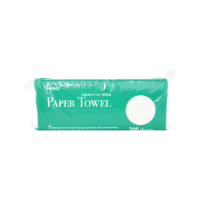 Biodegradable Sugarcane pulp hand towelsSugar cane pulp hand towels are usually hand towels made from sugar cane fiber as the main raw material. Paper towels made from sugar cane pulp are natural, renewable ...View Product →
Mills that build their lines around non-wood and recycled stock, such as MIOV's raw material program, can usually quote those grades without the swings that follow virgin pulp indices.
Packaging and Container Economics
Tissue almost always cubes out before it weighs out: a 40-foot high cube with roughly 76 cubic metres of usable volume fills up at around 9 to 12 tonnes of finished tissue, far below the 26 to 28 tonne payload limit.
- Palletized loads on 1.2 by 1.0 metre pallets give up 5 to 8 percent of volume but cut unloading time at the destination warehouse
- Hand-stacked cases recover that volume but need a loading plan with photo confirmation before the doors close
- Cartons should be sized to the retail case so pack count and shelf presentation stay identical between reorders
- A polythene liner or desiccant sachet protects rolls against condensation on long sea legs
Humidity is the silent cargo risk. Tissue absorbs moisture in transit, gaining weight and losing tensile strength, so a liner bag inside each carton and a dry container survey before loading cost far less than a rejected container of soft, sagging rolls.
Documents and Tests That Decide Whether the Container Ships
The export process runs as a fixed sequence, and each step produces a document that customs or the buyer can request months later.
- Specification and sample approval: lock grammage tolerance, ply, sheet size, pack count, and artwork.
- Production scheduling and raw material release: check incoming fiber batch codes against the approved grade.
- In-line and final quality control: grammage, moisture, tensile strength, absorbency, sheet count, and microbial testing.
- Packing and palletizing: case drop test, pallet pattern photo, and a container loading plan.
- Documentation: commercial invoice, packing list, bill of lading, certificate of origin, and heat-treated pallet stamps under ISPM 15.
- Loading, sealing, and sailing: seal number recorded and matched to the bill of lading.
Regulatory paperwork changes by origin. Australia, for example, requires a waste export licence before regulated waste paper and cardboard can leave the country, and mixed grades attract closer scrutiny than single-grade recovered fiber. Kitchen paper sold into food-service channels may also need food-contact documentation in the destination market.
Keep one master document pack per order: specification sheet, test report, packing photo set, and bill of lading. When a buyer's customs broker asks a question nine months later, that folder answers it in minutes.
Frequently Asked Questions
What is the difference between exporting recovered paper and exporting finished tissue?
Recovered paper is a commodity traded by weight under HS 4707, usually governed by waste-shipment licensing, with price set by fiber grades such as OCC and mixed paper. Finished tissue is a consumer product traded by case under HS 4818, governed by retail specification, absorbency performance, and packaging artwork. Freight terms, documentation, and payment conditions differ as much as the products do.
Which HS code applies to toilet paper and hand towels?
Household toilet paper, facial tissue, hand towels, and napkins fall under HS 4818. Jumbo reels and mother rolls sold to converters usually sit under HS 4803, while recovered fiber stays in HS 4707.
How much tissue fits in a 40-foot container?
Plan by volume, not weight. A 40-foot high cube holds about 76 cubic metres of usable space and normally fills at 9 to 12 tonnes of finished tissue. Palletized loads carry slightly less than hand-stacked cases, and carton dimensions decide the difference.
How long does a first tissue order take from China?
Allow four to six weeks for sample approval and artwork confirmation, then three to five weeks for production, plus sea transit of roughly two to four weeks to major Asian ports and four to six weeks to Europe or North America. Repeat orders usually skip the sampling stage.
Send the specification sheet with your enquiry, not after the quotation. Grammage, ply, sheet size, pack count, and destination port change a CIF price far more than volume discounts do.
Paper exports reward buyers who think in cubic metres, tolerance bands, and document sets rather than in headline prices per case. The category codes, the fiber mix, and the container plan are all decided long before the vessel sails.
MIOV (Jiangsu MIOV Paper Industry Co., Ltd.) has manufactured tissue for export buyers since 2007, with lines built around bamboo, sugarcane, recycled, and wood pulp grades and more than one million cases shipped to Japan each year. If you want a quotation that reflects your actual specification instead of a generic list price, send your specification and destination port and we will price the container.


ADD:No. 38 Huipu Road, Baipu Town, Rugao City, Jiangsu Province
Contact us
-

Tel: +86-513-88579198 88572918
-

FAX: +86-513-88572818
-

Email: info@tojin.com.cn

Copyright © 2002 - 2024 Jiangsu MIOV Paper Industry Co., Ltd. All Rights Reserved. Recycled Paper Towel Manufacturers

